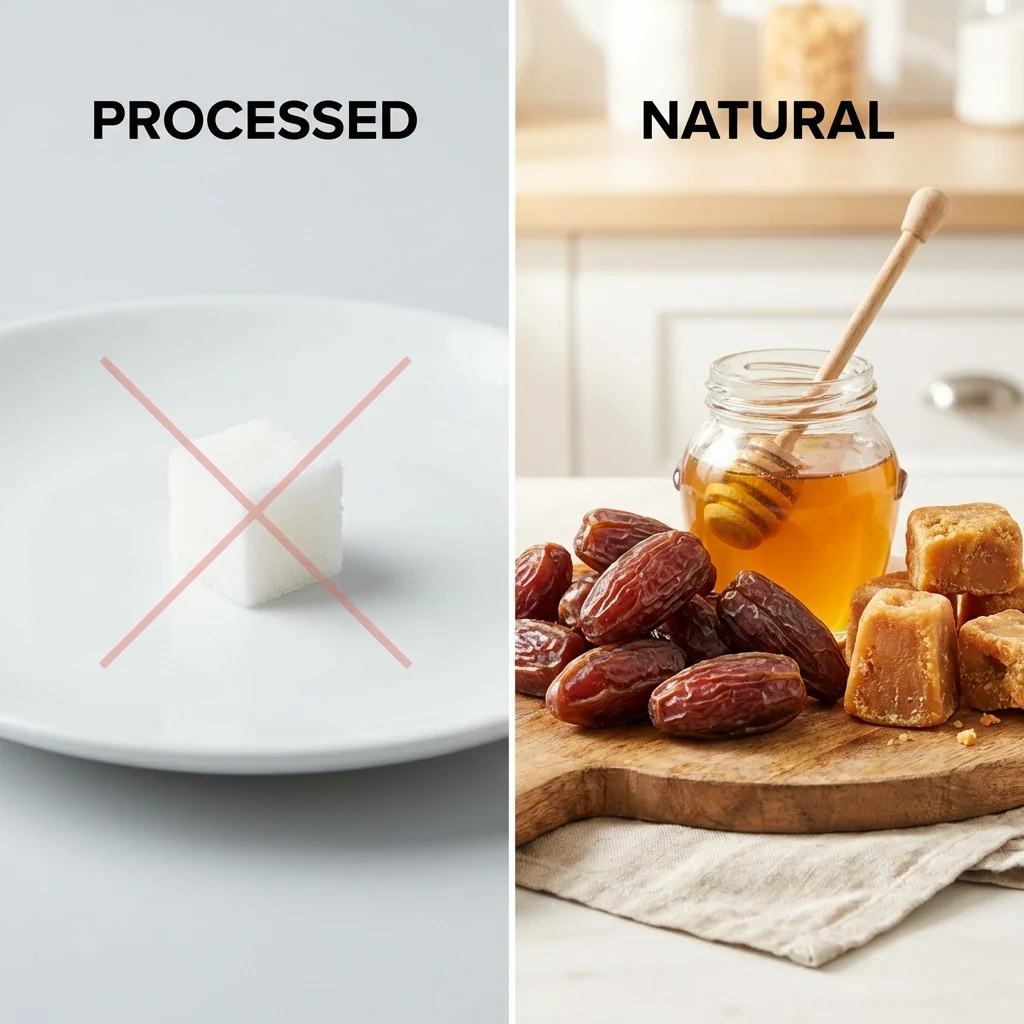
Sugar vs Jaggery: Which Is Better for Kids? A Parent's Complete Guide
Ask any Indian grandmother and she'll tell you: jaggery (gur) is the healthy one. Ask a food label and it'll proudly say "No Added Sugar." Meanwhile, toddlers genuinely need energy, and nature made energy taste sweet.
So where does that leave a parent standing in the kitchen with a spoon of jaggery in one hand and white sugar in the other? Is one really better for your child — and by how much? This is the complete, myth-busting guide to sugar vs jaggery for kids: what each actually is, how they compare nutritionally, when (and whether) to give jaggery to children, and the healthier habits that matter more than either.
Key Takeaways
- Both white sugar and jaggery are "added sugars" — they raise blood sugar and count toward your child's daily sugar limit.
- Jaggery is nutritionally better than refined sugar because it keeps trace minerals like iron and is less processed — but it's still ~85–90% sugar.
- Never give any added sweetener under 1 year; keep it very limited for toddlers.
- The real win isn't picking a sweetener — it's building a palate around whole foods like fruit and dates and reading labels for hidden sugars.
What Is White Sugar?
White sugar (sucrose) is made by extracting juice from sugarcane or beet, then refining, bleaching, and crystallising it until nothing is left but pure sucrose. That heavy processing strips away every trace of the plant's original minerals and fibre.
- Nutritional profile: essentially pure carbohydrate — no meaningful vitamins, minerals, or fibre.
- Calories: roughly 4 kcal per gram (~16 kcal per teaspoon).
- Glycemic impact: high — it digests almost instantly, spiking blood sugar and producing the classic "sugar rush → crash" cycle.
- Why it's everywhere: it's cheap, consistent, dissolves easily, and has a long shelf life, which is exactly why it dominates packaged biscuits, drinks, and sweets.
| Nutrient | White Sugar (per 100g) |
|---|---|
| Calories | ~387 kcal |
| Minerals | Negligible |
| Fibre | 0 g |
| Processing | Heavily refined & bleached |
What Is Jaggery?
Jaggery is made the traditional way: sugarcane (or palm) juice is boiled down and set into blocks without refining or bleaching. Because it skips the stripping step, it holds on to some of the minerals the plant originally contained.
Types of jaggery:
- Sugarcane jaggery — the common golden-brown gur.
- Palm jaggery (karupatti / date-palm) — darker, deeper flavour, often richer in minerals.
- Coconut jaggery — made from coconut-flower sap, popular in coastal regions.
| Nutrient | Jaggery (per 100g, approx.) |
|---|---|
| Calories | ~383 kcal |
| Iron | Present (varies widely by source) |
| Calcium | Small amounts |
| Potassium / Magnesium | Trace amounts |
| Processing | Minimally processed, unrefined |
The catch is right there in the calorie line: jaggery has almost the same calories as white sugar. Its advantage is the trace minerals that come along — not fewer calories or a free pass.
Sugar vs Jaggery: The Nutritional Comparison
| Factor | White Sugar | Jaggery |
|---|---|---|
| Calories | ~387 kcal/100g | ~383 kcal/100g |
| Carbohydrate | ~100% sucrose | ~85–90% sugars |
| Iron | None | Present (variable) |
| Calcium / Potassium / Magnesium | None | Trace amounts |
| Vitamins | None | Very small amounts |
| Glycemic impact | High | High (slightly lower, still significant) |
| Processing | Heavily refined | Minimally processed |
| Taste | Clean sweet | Deep, caramel, molasses-like |
| Shelf life | Very long | Shorter; can attract moisture |
Bottom line: jaggery edges out white sugar on minerals and processing — but on the metric that matters most for kids (blood-sugar impact and total sugar), the two are far closer than tradition suggests.
Is Jaggery Actually Healthier?
Advantages of jaggery
- Less processed — closer to its natural form.
- Contains trace minerals (notably some iron) that refined sugar lacks entirely.
- A traditional ingredient with a rich, satisfying flavour, so a little goes a long way.
- May carry small amounts of antioxidants and plant compounds.
Limitations of jaggery
- Nearly identical calories to white sugar.
- Still raises blood sugar meaningfully.
- Not safe in unlimited quantities — "natural" doesn't mean "unlimited."
- Quality varies enormously; cheap jaggery can contain impurities from poor processing.
Jaggery is nutritionally better than refined sugar — but it is not a free-pass health food. Treat it as "the better added sugar," not as a nutrient your child needs.
Can Kids Eat Jaggery? Age-Wise Guidance
- Below 1 year: Avoid all added sweeteners, jaggery included. Babies don't need added sugar, and early exposure trains a preference for intense sweetness. (This is also the window where honey is off-limits due to botulism risk.)
- 1–2 years: Very limited amounts only — a hint in porridge occasionally, not a daily habit.
- Above 2 years: Occasionally acceptable in moderation, ideally within home-cooked food rather than packaged sweets.
Also mind the practical stuff: hard jaggery lumps can be a choking risk for little ones (grate or dissolve it), and hygiene matters since loosely-sold jaggery can pick up contaminants.
When Should Parents Avoid Giving Jaggery?
- Diabetes or blood-sugar issues — jaggery spikes glucose much like sugar.
- Tooth decay — sticky sweeteners cling to teeth; jaggery is no gentler on cavities.
- Excess consumption — the calories add up fast and crowd out nutrient-dense foods.
- Poor-quality jaggery — cheaper varieties may carry processing contaminants.
- Allergy (rare) — discontinue if you notice any reaction.
Sugar vs Jaggery for Different Situations
| Situation | Better Choice |
|---|---|
| Everyday cooking | Jaggery (in moderation) |
| Baking | White sugar (behaves predictably) — or dates for a healthier bake |
| Traditional sweets | Jaggery (authentic flavour) |
| Iron intake | Jaggery > sugar, but food sources are far better |
| Sports / quick energy | Either works; whole fruit is better |
| Everyday desserts | Neither daily — reserve for occasions |
| Toddlers | Neither routinely; prefer fruit & dates |
Common Myths, Busted
Myth 1: "Jaggery doesn't raise blood sugar." It does. Jaggery is still mostly sugar and produces a significant glycemic response.
Myth 2: "Kids can eat unlimited jaggery because it's natural." Moderation still matters — the calorie and sugar load is nearly the same as white sugar.
Myth 3: "Brown sugar and jaggery are the same." They're not. Brown sugar is refined white sugar with a little molasses added back; jaggery is unrefined from the start.
Myth 4: "Jaggery cures anaemia." It contains some iron, but nowhere near enough to treat iron-deficiency anaemia — that needs real food sources and, often, medical treatment.
Healthier Ways to Cut Sugar in Your Child's Diet
Instead of debating which added sugar to use, shift the palate toward sweetness that comes packaged with nutrition:
- Whole fresh fruit — sweetness plus fibre, so no sharp spike.
- Dates — nature's superfood sweetener: fibre, iron, and B vitamins along for the ride.
- Banana or apple purée — natural sweetness for porridge, pancakes, and bakes.
- Unsweetened yogurt topped with fruit instead of sugared, flavoured cups.
- Homemade snacks where you control the sweetness.
- Cinnamon — adds a "sweet" perception with zero sugar.
This is exactly why Rise Kids snacks are sweetened primarily with dates and fruit rather than refined sugar — the sweetness earns its place by bringing nutrients too.
How to Read Labels for Hidden Sugar
Sweeteners hide under many names so "sugar" never appears at the top of an ingredient list. On any kids' snack, watch for: cane sugar, liquid glucose, glucose syrup, corn syrup, maltose, dextrose, fructose, invert syrup, fruit juice concentrate — and yes, jaggery and honey count too. Our 5-second food-label test shows exactly how to spot them fast.
When choosing a sweetened snack, look past the sweetener to the whole package: portion size, whole-food ingredients, fibre and protein, and the absence of artificial additives. A snack sweetened with dates and built on whole grains is in a completely different league from a maida biscuit sweetened with liquid glucose — even if both taste sweet.
Frequently Asked Questions
Is jaggery better than sugar for children? Slightly — jaggery is less processed and retains trace minerals like iron. But both are added sugars with similar calories and blood-sugar impact, so "better" doesn't mean "give freely."
Can toddlers eat jaggery? In very small amounts after age 1, occasionally. Under 1 year, avoid all added sweeteners. Grate or dissolve hard jaggery to avoid choking.
Which has more calories, sugar or jaggery? They're almost identical — both around 380–390 kcal per 100g. Jaggery is not a "low-calorie" sweetener.
Is jaggery safe to eat every day? Not in meaningful quantities. Like all added sugars, daily jaggery adds up. The WHO advises free sugars stay under 10% (ideally under 5%) of a child's daily calories.
Does jaggery improve immunity? There's no strong evidence it meaningfully boosts immunity. A balanced, nutrient-rich diet does far more for a child's immune system.
Does jaggery contain iron? Yes, some — but the amount varies a lot and it's not a reliable iron source. For iron, prioritise ragi, dates, legumes, and moringa.
Can jaggery replace sugar in baking? It can, but it changes moisture, colour, and flavour, and doesn't cream like sugar. For a genuinely healthier bake, date paste or banana often works better.
Is organic or "chemical-free" jaggery healthier? Better-quality jaggery avoids processing contaminants, which is a real plus — but it's still added sugar nutritionally.
Is palm jaggery better than sugarcane jaggery? Palm jaggery often has a slightly richer mineral profile and a lower glycemic response, but the difference is modest — both remain added sugars.
Can jaggery cause cavities? Yes. Being sticky, it clings to teeth and feeds cavity-causing bacteria just like other sugars. Rinse or brush after sweet foods.
Conclusion
Here's the honest, balanced verdict:
- Both sugar and jaggery are forms of added sugar.
- Jaggery offers small advantages — trace minerals and minimal processing — so if you're choosing between the two, jaggery wins.
- But moderation is what matters. An excess of either isn't good for a growing child.
- The real goal is bigger than the sweetener: build healthy eating habits around minimally processed, nutrient-dense foods, and reserve sweeteners for occasional treats.
Train your child's palate to love the deep caramel of dates and the natural sweetness of fruit, and the "sugar vs jaggery" question quietly stops mattering so much. See how Rise Kids keeps snacks naturally sweet.
References & Scientific Sources
- World Health Organization (WHO). "Guideline: Sugars intake for adults and children."
- ICMR-NIN 2020. Recommended Dietary Allowances & food composition (iron, calcium).
- American Heart Association. "Added Sugars and Cardiovascular Disease Risk in Children."
- American Academy of Pediatrics. "Infant botulism and honey; added sugars in early childhood."
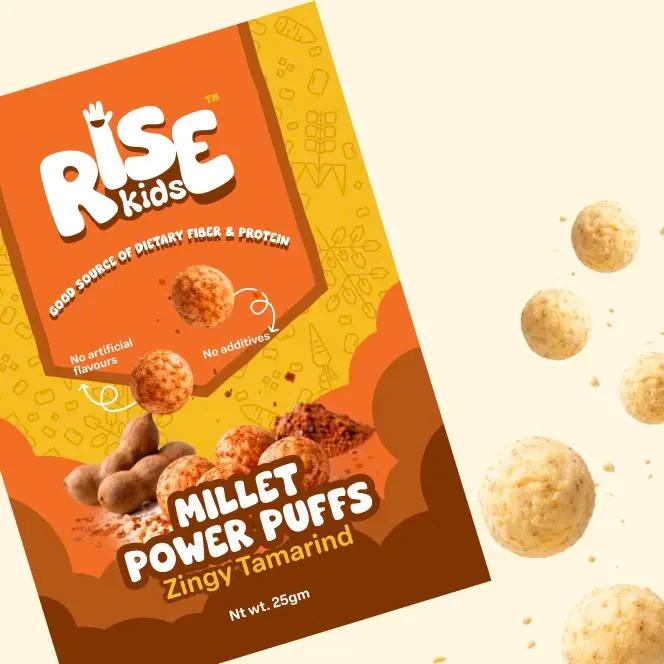
No maida. No palm oil. No nonsense.
Whole millets, natural seasoning, and calcium-rich goodness — snacking the way it should be.
Start here
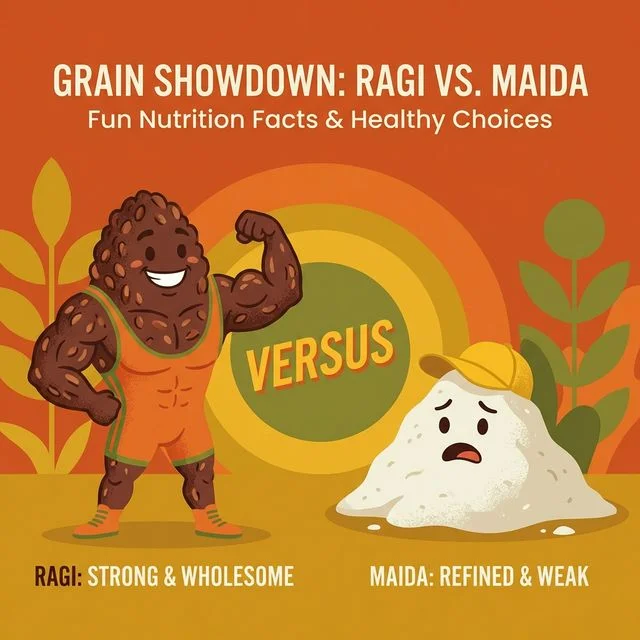
Ragi vs. Maida: The Nutrition Showdown Every Indian Parent Must See
Is Ragi really better than Maida? We break down the numbers. Spoiler: One builds bones, the other is just 'glue'.
Share this knowledge
Help other parents raise healthy champions!